Why some businesses scale successfully while others struggle, despite working just as hard.
Every business owner wants growth: more clients, stronger revenue, better profits and greater financial security. But sustainable business growth is not simply a case of working harder, selling more or hoping the numbers will take care of themselves.
Many profitable businesses run into difficulty during periods of growth because they expand without the financial structure needed to support that expansion. Costs increase, cash flow tightens, compliance deadlines become harder to manage, and the business starts to feel less controlled rather than more successful.
A practical business growth strategy should be built around a financial framework that allows a company to grow safely, intentionally and profitably. The five-part structure below gives business owners a clear way to think about stability, investment, funding, cash flow and risk.
Before a business can scale, it must first become financially stable. Growth can magnify existing weaknesses, so the basics need to be in place before the business commits to expansion.
-
Accurate bookkeeping and regular management reporting
-
Predictable monthly cash flow
-
A clear understanding of fixed and variable costs
-
Compliance processes for corporation tax, VAT and payroll
-
A cash reserve covering three to six months of fixed costs
Why this matters
Without a strong foundation, growth can create pressure rather than progress. Stable financial systems give business owners the confidence to make decisions based on facts, not guesswork.
Growth should be intentional. One of the simplest ways to make expansion more controlled is to ring-fence funds specifically for growth. This separates future investment from day-to-day operating cash.
A dedicated growth fund can support equipment, recruitment, marketing, technology, product development or business expansion projects. The important point is that the money is allocated before the opportunity or pressure arrives.
-
Allocate a consistent percentage of revenue or profit
-
Set realistic return-on-investment expectations
-
Build a 10% to 20% risk buffer inside the growth pot
-
Track progress against clear objectives
Not all business growth finance should come from the same source. The right funding mix depends on growth speed, risk tolerance, ownership preferences, sector, business model and cash flow stability.
| Funding Source | Examples |
|---|---|
| Internal funding | Profits, reserves and retained earnings |
| External funding | Loans, grants and government-backed finance |
| Tax-efficient funding | Capital allowances, pension planning and relevant incentives |
| Owner funding | Director’s loans or reinvested dividends |
Cash flow management is often the difference between successful growth and financial strain. A business can appear profitable on paper but still struggle if money is not arriving when it is needed.
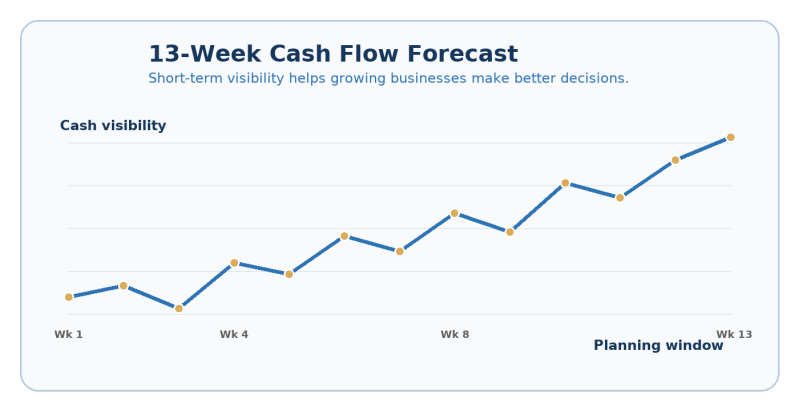
For growing businesses, a rolling 13-week cash flow forecast can provide short-term visibility. It helps business owners understand what is expected to come in, what is expected to go out and where pressure points may appear.
-
Effective credit control systems
-
Optimised payment terms
-
Supplier negotiation
-
Deposits and staged payment arrangements
-
Rolling 13-week cash flow forecasts
Growth increases risk. More staff, larger overheads, new commitments and greater operational complexity all create additional financial exposure. Risk controls help keep growth manageable.
-
Spending caps
-
Investment checkpoints
-
Scenario planning
-
Contingency reserves
-
Insurance and legal protections
-
Monthly performance reviews
The goal
Risk controls are not designed to stop ambition. They are designed to stop a growing business from overstretching too quickly.
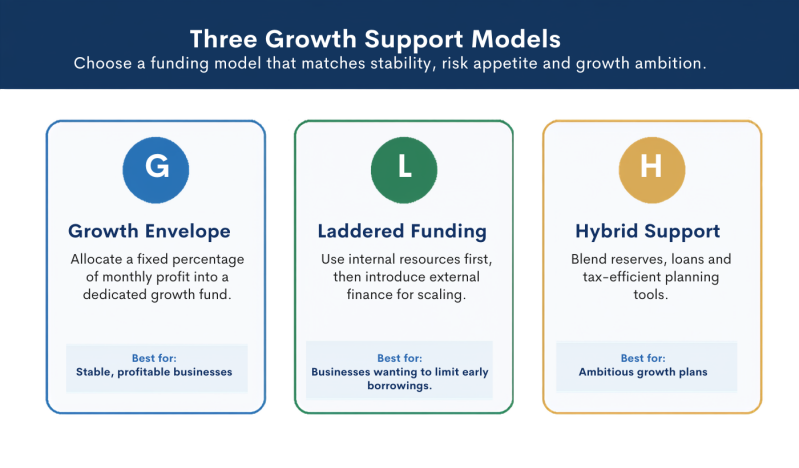
There is no single route to small business growth. The right model depends on the stability of the business, how quickly growth is required and how much risk the owner is willing to accept.
| Model | How it works | Best suited to |
|---|---|---|
| Growth Envelope Model | Allocate a fixed percentage of monthly profit into a dedicated growth fund. | Stable and consistently profitable businesses. |
| Laddered Funding Model | Use internal resources first, then introduce external finance for scaling. | Businesses wanting to reduce early borrowing. |
| Hybrid Support Model | Blend retained reserves, loans and tax-efficient planning strategies. | Businesses with ambitious growth objectives. |